About me

My research examines human capital and skill formation among children and adults, as well as the transmission of human capital across generations. I study how cognitive and noncognitive skills, educational institutions, and public policies shape inequality, economic opportunity, and well-being across the life course, particularly in low-income countries. My work covers foundational learning, intergenerational mobility, gender disparities in labor markets, and education policy.
‍
My job market paper, “Cognitive Enrichment and Human Capital: Experimental Evidence from Developing Countries,” addresses one of the most pressing challenges in global education: many children attend school without acquiring foundational skills. The paper asks whether schools can improve children’s capacity to learn, rather than only increasing their exposure to instruction. Across randomized experiments involving more than 2,600 primary-school students in Kenya and Malawi, I study chess as a low-cost, school-based activity that provides repeated practice in planning, attention, and strategic reasoning. The program increased children’s cognitive performance by 0.14–0.19 standard deviations, with closely replicated effects across countries and implementation scales. The findings show that foundational cognitive skills remain malleable during primary school and that cognitively demanding enrichment can complement conventional efforts to improve instruction.
‍
My research agenda is shaped not only by methodology but also by lived experience. I grew up in Mongolia in a context with limited educational resources and now conduct field research across sub-Saharan Africa. This trajectory informs both the questions I ask and how I design and interpret my work in context. My work has been funded by J-PAL, the Weiss Fund, and CEGA, among others, and I am a Rocca Dissertation Fellow at Berkeley’s Center for African Studies. Prior to my Ph.D., I worked as a Senior Research Analyst at the Federal Reserve Bank of New York. Outside of academia, I am a National Chess Master and Woman FIDE Master. Long before chess became the subject of my research, it was a discipline I pursued competitively—shaping my interest in how cognitively demanding activities can transform learning.

My journey

Sukhbaatar city, Selenge Province, Mongolia

I was born in a small town near the Russian border in Mongolia, with a population of less than two thousand people.

I was born in a small town near the Russian border in Mongolia, with a population of less than two thousand people. To provide me with more educational opportunities, my family moved to Sukhbaatar, the capital of Selenge Province, where I spent my childhood and attended public school. I graduated high school as valedictorian, achieving the highest score in mathematics on the national university entrance exam, which secured my acceptance to the University of Finance and Economics. At the end of my sophomore year, I had the opportunity to work and study in the United States—an experience that, unexpectedly, changed my life forever.

To provide me with more educational opportunities, my family moved to Sukhbaatar, the capital of Selenge Province, where I spent my childhood and attended public school. I graduated high school as valedictorian, achieving the highest score in mathematics on the national university entrance exam, which secured my acceptance to the University of Finance and Economics. At the end of my sophomore year, I had the opportunity to work and study in the United States—an experience that, unexpectedly, changed my life forever.

University
of California, Berkeley

In 2009, during the Great Recession, I immigrated to the United States alone, without speaking the language and with no financial support.

In 2009, during the Great Recession, I immigrated to the United States alone, without speaking the language and with no financial support. An easy path lay before me in Mongolia, the country I had grown up in—security, a good degree, a steady job. Yet, after much deliberation, I decided to stay in America seeking riskier but more expansive opportunities. It was one of the most courageous decisions of my life, and it would shape my journey in ways I never imagined.

Starting over in a new country was not easy. I worked full-time at minimum wage jobs while attending community college part-time. Every day, I faced language barriers and cultural differences, yet I remained focused on my ultimate goal: education. Along the way in America, I rediscovered my passion for competing in chess. I honed my skills and soon began competing professionally, but the real transformation came when I started teaching chess to elementary school children. Chess became my tool for connection, a way to communicate without words and to empower young minds.
‍
After seven years away from my academic journey, I was finally accepted to the University of California, Berkeley, as a transfer student. It felt like a dream come true—a moment when I, like a fish released from an aquarium into the vast ocean, found my true potential.

Looking back, I chose the unknown and rocky path, I would not alter one step. The risks I took, the challenges I faced, and the unexpected opportunities I embraced all led me to where I am today.

This is some text inside of a div block.

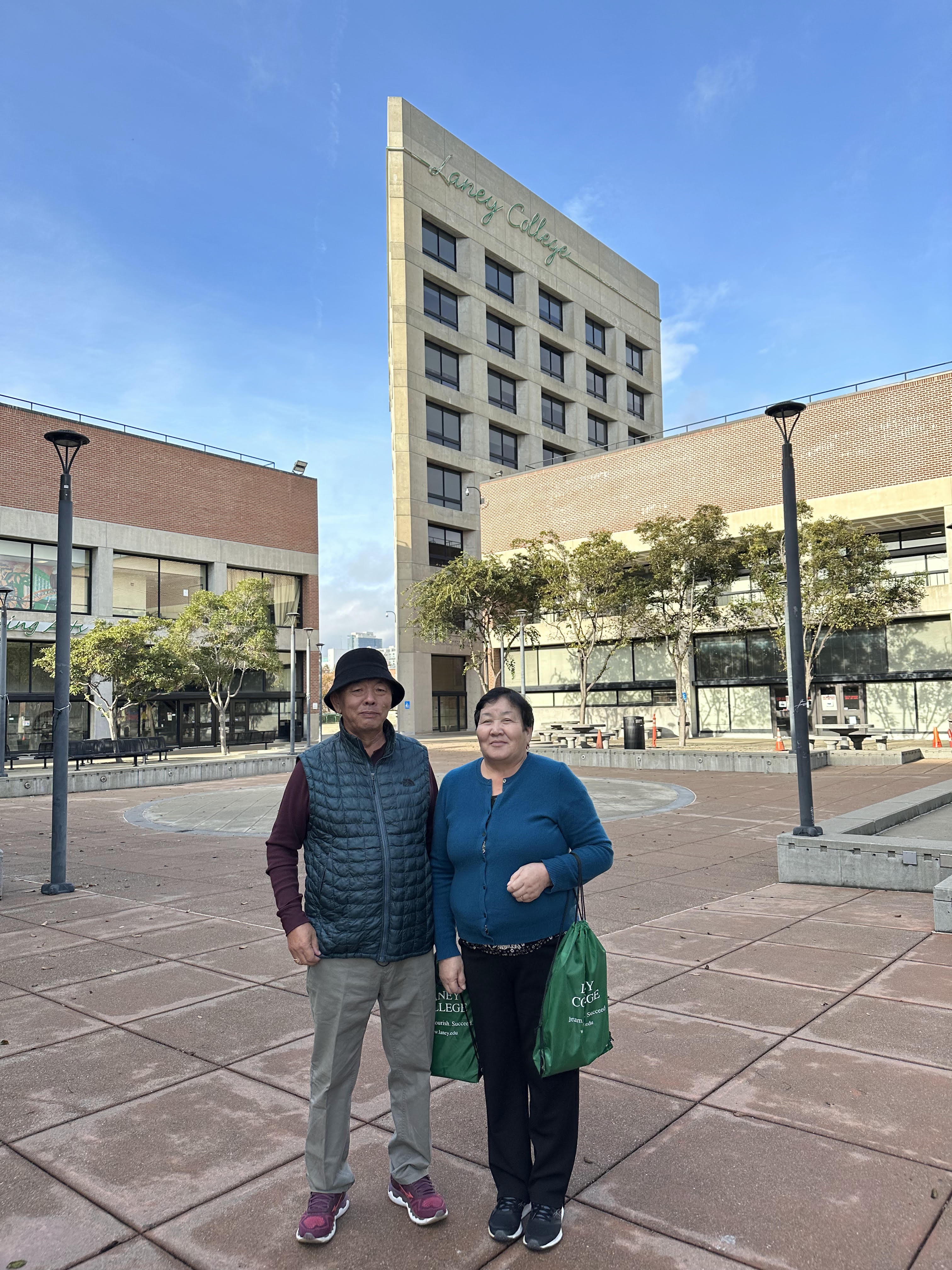
( My parents in front of Laney Community College, where I began my higher-education journey in the US. They were visiting from Mongolia when I returned to campus as a panelist for an event hosted by the Mongolian Student Association.)
‍
‍

An easy path lay before me in Mongolia, the country I had grown up
in—security, a good degree, a steady job. Yet, after much deliberation, I decided to stay in America seeking riskier but more expansive opportunities. It was one of the most courageous decisions of my life, and it would shape my journey in ways I never imagined.

Starting over in a new country was not easy. I worked full-time at minimum wage jobs while attending community college part-time. Every day, I faced language barriers and cultural differences, yet I remained focused on my ultimate goal: education. Along the way in America, I rediscovered my passion for competing in chess. I honed my skills and soon began competing professionally, but the real transformation came when I started teaching chess to elementary school children. Chess became my tool for connection, a way to communicate without words and to empower young minds.

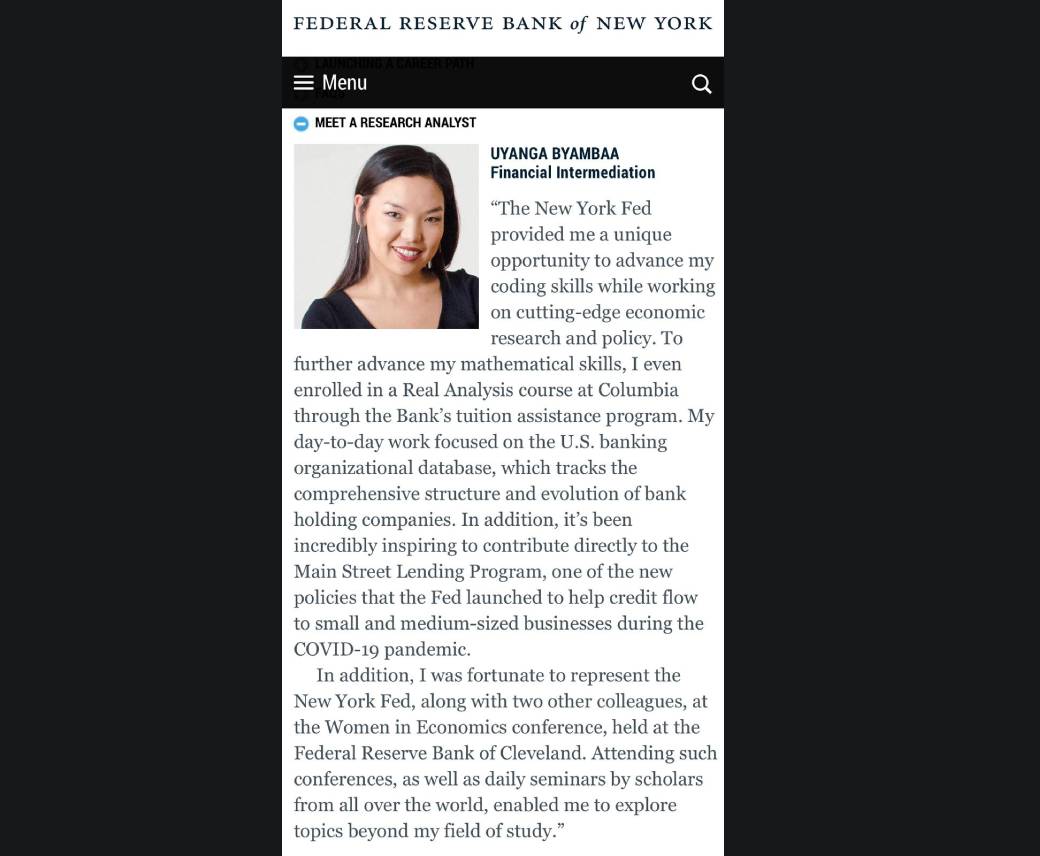
Federal Reserve Bank of New York

After graduating from UC Berkeley with distinct honors,
I went on to work at the Institute for Research on Labor
and Employment (IRLE) and later as a Senior Research
Analyst at the Federal Reserve Bank of New York.

After graduating from UC Berkeley with distinct honors,
I went on to work at the Institute for Research on Labor
and Employment (IRLE) and later as a Senior Research
Analyst at the Federal Reserve Bank of New York.
During the 2009 Great Recession, my path was deeply affected as an immigrant navigating new challenges.
Then, a decade later during the COVID-19 recession
in 2019, I found myself on the other side, analyzing
economic impacts from within the Federal Reserve.
It was a full-circle moment.

During the 2009 Great Recession, my path was deeply affected as an immigrant navigating new challenges. Then, a decade later during
the COVID-19 recession in 2019, I found myself on the other side, analyzing economic impacts from within the Federal Reserve.
It was a full-circle moment.

Berkeley Economics

(Celebrating Professor David Card’s Nobel Prize during my first year as a PhD student with my colleagues)

My academic journey has come full circle at Berkeley, my undergraduate alma mater, where my passion for economics first took shape. I am delighted to have returned to pursue my Ph.D. in Economics in the community that first inspired me to become an economist.

C

I’m extremely happy to be back at Berkeley, pursuing my doctoral program in Economics, the very place where my passion
for economics was first sparked as an undergraduate.
There’s nowhere else I’d rather be.